Can You Really "Close the Gap?" What the Latest Research Says About Diastasis Recti
If you're wondering whether exercises can "fix" diastasis recti, the short answer is: not simply by closing the gap. The latest research suggests that recovery is better measured by improvements in strength, function, symptoms, and confidence than by the distance between the abdominal muscles.
If you've recently had a baby, chances are you've heard about diastasis recti—the separation of the abdominal muscles that commonly occurs during pregnancy. Scroll through social media, and you'll find countless programs promising to "close the gap" with the right exercises, leaving many new moms wondering if they're doing enough or whether they're exercising correctly.
But what if we've been focusing on the wrong goal?
Quick Answer
A recent systematic review of 15 randomized controlled trials involving more than 800 postpartum women found that exercise alone does not consistently reduce the width of a diastasis recti.
That doesn't mean exercise—or physical therapy—isn't effective.
Quite the opposite.
Exercise remains one of the most important tools we have for postpartum recovery. The difference is that its greatest benefits may not be reflected by a tape measure or finger-width assessment.
Instead, rehabilitation should focus on helping you:
Move with confidence
Restore strength and coordination
Improve breathing and pressure management
Reduce pain
Address pelvic floor symptoms
Return safely to the activities you love
That's what recovery is really about.
What Is Diastasis Recti?
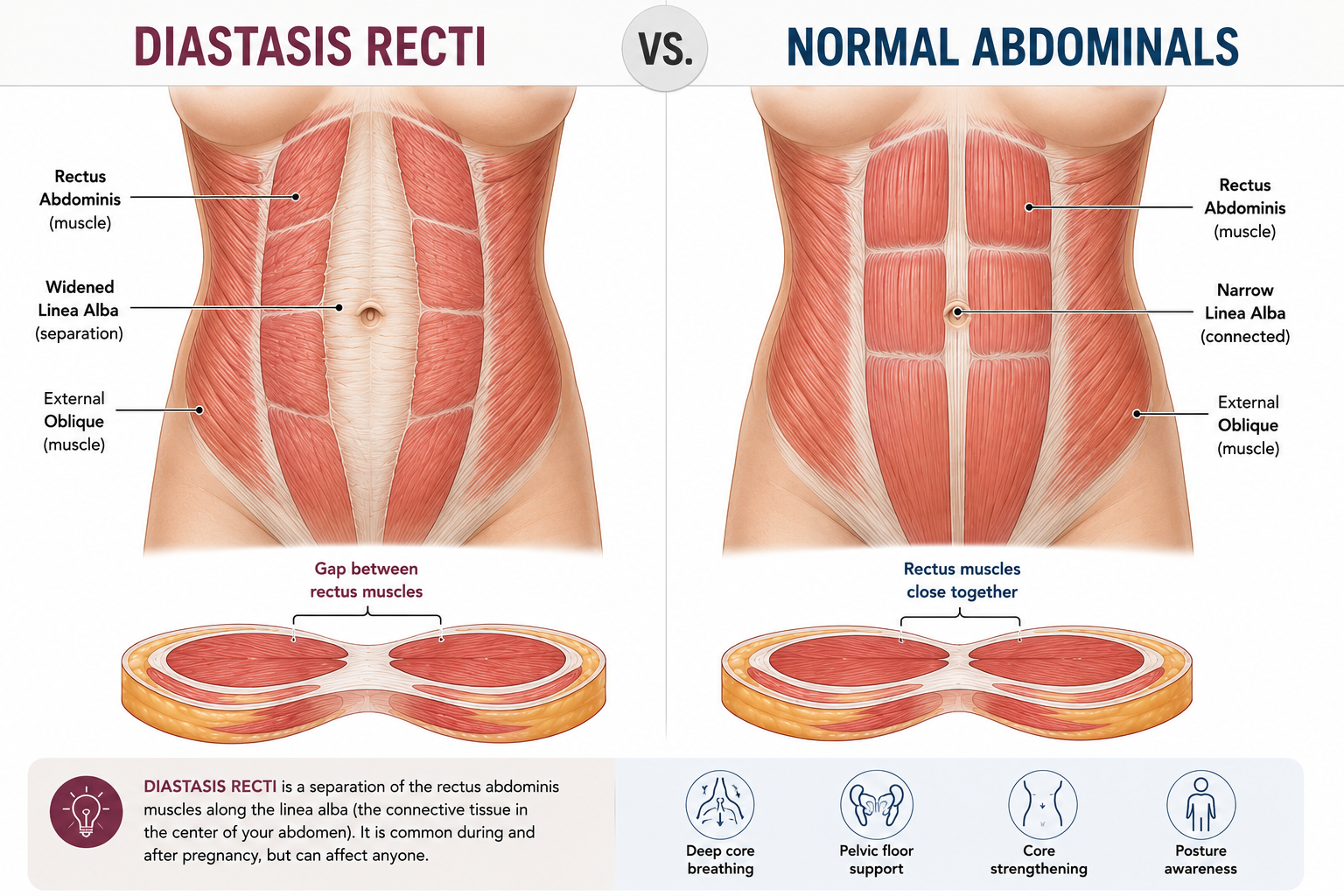
Diastasis recti is a stretching and separation of the connective tissue (the linea alba) between the two sides of the rectus abdominis ("six-pack") muscles. It develops as the abdomen expands during pregnancy and is a completely normal adaptation that allows room for your growing baby.
In fact, nearly all women develop some degree of diastasis recti during late pregnancy. Many experience natural recovery during the first several months postpartum, while others continue to have a measurable separation months or even years later.
The important thing to know is this:
Having a diastasis recti does not automatically mean something is wrong.
How Do I Know If I Have Diastasis Recti?
Some people notice obvious changes in their abdomen, while others have few symptoms at all.
Common signs may include:
A visible bulge or "doming" through the middle of the abdomen during certain movements
Feeling like your core is weak or unsupported
Difficulty generating strength during lifting or exercise
Persistent abdominal fullness after pregnancy
Low back or pelvic pain
Urinary leakage or feelings of pelvic heaviness
However, many people with diastasis recti have very few symptoms, while others with only a small separation experience significant difficulty.
That's one reason why measuring the separation alone doesn't tell the whole story.
Does Exercise Actually Close Diastasis Recti?
A recently published systematic review and meta-analysis evaluated 15 randomized controlled trials involving more than 800 postpartum women to answer an important question:
Can exercise actually reduce the width of a diastasis recti?
The researchers found that, while exercise offers many benefits after pregnancy, current evidence does not consistently show that exercise alone significantly reduces the width of the abdominal separation.
At first glance, that might sound discouraging.
But that's not the same thing as saying exercise doesn't work.
In fact, exercise remains one of the most valuable tools we have during postpartum recovery. The research simply suggests that its greatest benefits may not be reflected by a measurement of the distance between the abdominal muscles.
Exercise can improve:
Strength
Muscle coordination
Endurance
Breathing mechanics
Pressure management
Confidence in movement
Overall function
Rather than asking,
"Did my gap get smaller?"
a better question might be:
"Can I move, lift, exercise, and live with less pain and more confidence?"
That's a much more meaningful measure of recovery.
The Biggest Myth About Diastasis Recti
For years, postpartum recovery has been judged by one measurement: the width of the abdominal separation.
The newest research suggests that may be the wrong way to define success.
Recovery is better measured by improvements in function, symptoms, strength, confidence, and quality of life than by whether your abdominal muscles move a few millimeters closer together.
If there's one thing we hope every postpartum mom remembers, it's this:
Your recovery should not be judged by the size of your gap.
The width of the separation is only one piece of the puzzle.
Some women have a relatively wide diastasis and experience little to no pain or limitation.
Others have only a small separation but struggle with:
Low back pain
Pelvic pain
A feeling of core weakness or instability
Difficulty lifting, exercising, or carrying their baby
Urinary leakage
Pelvic heaviness or pressure
Difficulty returning to running, lifting, or other activities they enjoy
Research continues to show that the size of a diastasis does not always predict symptoms, function, or quality of life.
At PelviCore, we don't treat numbers—we treat people.
So Where Does Physical Therapy Fit In?
This is where pelvic floor physical therapy becomes so valuable.
Instead of asking only,
"How wide is the gap?"
we ask much more meaningful questions.
How is your core functioning?
How well do your abdominal muscles coordinate during movement?
How do you manage pressure when you lift, cough, laugh, or carry your baby?
Is your pelvic floor working together with your abdominal wall?
What's preventing you from getting back to the life you want to live?
At PelviCore, our evaluation goes far beyond measuring the distance between your abdominal muscles.
We assess:
Deep core muscle coordination
Breathing mechanics
Pressure management
Pelvic floor muscle function
Posture and movement strategies
Hip, trunk, and whole-body strength
Mobility restrictions
Functional movement patterns
The symptoms that are actually affecting your daily life
Because every postpartum recovery is unique, your treatment plan should be too.
There is no one-size-fits-all exercise program.
What Physical Therapy Can Help With
The goal of rehabilitation isn't simply to make an abdominal measurement smaller.
The goal is to help you return to living your life with confidence.
Physical therapy can help you:
Improve core strength and coordination
Reduce back, pelvic, and abdominal discomfort
Address urinary leakage and pelvic floor dysfunction
Safely return to exercise, lifting, and running
Improve movement efficiency and pressure management
Build confidence in your body's ability to move
Those improvements often have a much greater impact on quality of life than whether your separation measures one finger width or two.
Recovery Looks Different for Everyone
Healing after pregnancy isn't about achieving a perfectly flat stomach.
It isn't about eliminating every millimeter of separation.
It's about feeling strong enough to:
Pick up your child without pain
Exercise without fear
Laugh, cough, or sneeze without leaking
Return to work, sports, and the activities you love
Feel confident in your body again
That's what meaningful recovery looks like.
What We Still Don't Know
Diastasis recti research is continuing to evolve.
One challenge is that studies use different exercise programs, ways of measuring the separation, and definitions of success. Researchers are still working to determine which rehabilitation strategies are most effective and which women benefit most from specific interventions.
While we continue learning, one message remains consistent:
Postpartum rehabilitation should focus on improving function, symptoms, confidence, and quality of life—not simply the distance between the abdominal muscles.
The Bottom Line
The latest research doesn't tell us that exercise is ineffective.
It tells us we're measuring success the wrong way.
Exercise remains one of the most valuable tools for postpartum recovery. It helps rebuild strength, improve coordination, restore confidence, and support a safe return to the activities you love.
Success shouldn't be judged solely by whether the abdominal gap becomes smaller.
Instead, ask yourself:
Do I feel stronger?
Can I move with more confidence?
Am I having less pain?
Are my pelvic floor symptoms improving?
Can I return to the activities that matter most to me?
Do I trust my body again?
Those are the outcomes that truly matter.
At PelviCore Physical Therapy & Wellness, we believe your body is more than a measurement.
Our goal isn't simply to help you "close the gap."
Our goal is to help you understand your body, improve how it functions, and help you return to the life you want to live with confidence.
Frequently Asked Questions
Can physical therapy close diastasis recti?
Physical therapy may improve the function of your abdominal wall, but current evidence does not consistently show that exercise alone reduces the width of the separation. Treatment focuses on improving strength, coordination, movement, and symptoms that affect your daily life.
Does the size of my diastasis matter?
Not necessarily. Some people have a larger separation with excellent function, while others have a smaller separation but significant pain or weakness. Your symptoms and how your body functions are often more important than the measurement itself.
Will diastasis recti heal on its own?
Many women experience some natural recovery during the first several months after giving birth. Others continue to have a measurable separation long-term. Whether treatment is appropriate depends less on the measurement itself and more on your symptoms, goals, and functional limitations.
Is diastasis recti dangerous?
Diastasis recti itself is generally not considered dangerous. However, if you're experiencing pain, weakness, pelvic floor symptoms, or difficulty returning to exercise or daily activities, an evaluation by a pelvic floor physical therapist can help determine the best treatment approach.
Can I exercise if I have diastasis recti?
In most cases, yes. Exercise is generally encouraged, but the right program depends on your symptoms, goals, movement patterns, and stage of recovery. A pelvic floor physical therapist can help determine which exercises are most appropriate for you.
Should everyone with diastasis recti see a physical therapist?
Not everyone needs treatment. However, if you're experiencing pain, feelings of weakness, urinary leakage, pelvic heaviness, or difficulty returning to the activities you enjoy, an individualized evaluation can help identify contributing factors and create a plan that's right for you.
References
Martín-Corrales C, et al. Effectiveness of abdominal and pelvic floor muscle training in postpartum women with diastasis recti abdominis: A systematic review and meta-analysis. Journal of Women's & Pelvic Health Physical Therapy. 2025.
Benjamin DR, van de Water ATM, Peiris CL. Effects of exercise on diastasis recti abdominis in the antenatal and postnatal periods: A systematic review. Physiotherapy. 2014.